Google AI Mode in Türkiye: how does your brand stay visible as clicks decline?
Since 18 February 2026, Google has been gradually rolling out AI Mode and AI Overviews in Türkiye. Search results now start with an answer — is your brand the source of that answer, or buried beneath it?
By Dokuzbir
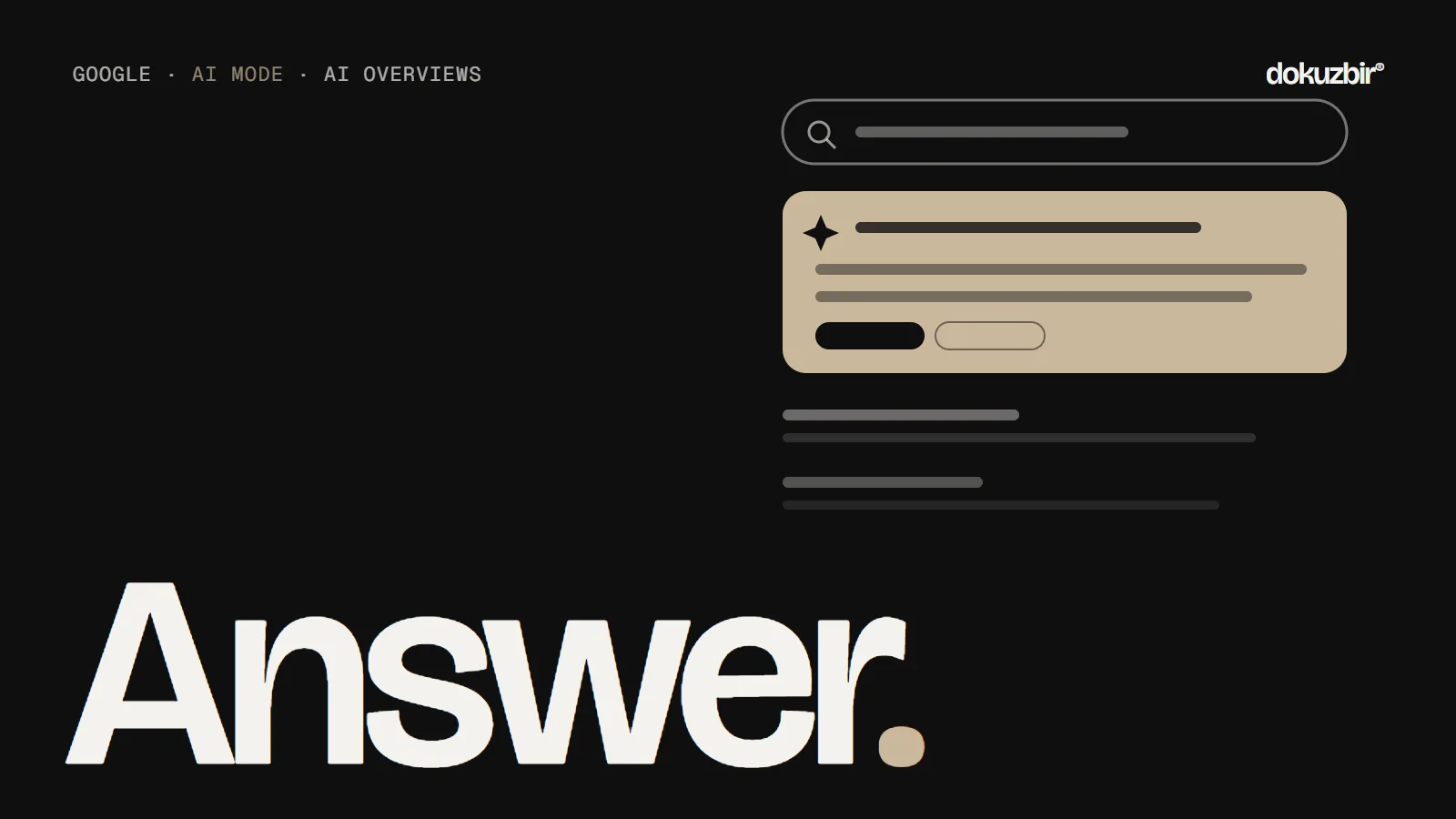
Short answer: Google AI Mode and AI Overviews put an AI-written answer at the top of the results page. On searches where that summary appears, clicks on classic results drop sharply — but brands cited as a source in the summary get about twice as many clicks as those that aren’t. The goal is no longer just ranking; it’s being inside the answer.
What changed in Türkiye?
On 18 February 2026, Google announced that it had started rolling out AI Mode and AI Overviews in Türkiye. Both features run on the Gemini 3 model family and are being released gradually, so not everyone sees them at the same time.
- AI Overviews show a summary of the topic, with links, at the top of the results page.
- AI Mode is a separate, conversational search experience. It splits a question into subtopics and runs many searches at once (Google calls this query fan-out), accepts follow-up questions, and takes questions by text, voice or a photo taken with the phone camera.
Ads stay where they are for now. What changes is that an “answer layer” now sits in front of the organic results.
What happens to clicks? The data
There is no comprehensive Türkiye-specific study yet, but these features have been live in the US for longer, and the data there shows the direction:
- In a Pew Research Center study based on the real browsing data of 900 US adults in March 2025, people clicked a classic result on 8% of searches with an AI summary, versus 15% without one. Clicks on links inside the summary were just 1%. And 26% of searches with a summary ended without visiting another page.
- According to Seer Interactive’s 2026 update, covering 53 brands and 2.4 billion organic impressions, organic CTR on queries with an AI Overview fell to 1.31% in December 2025 and recovered to 2.36% in February 2026. On queries without an overview, the same rate was 3.82%.
- The study’s most important finding: on informational searches, brands cited as a source in the overview had an organic CTR of 2.07%, versus 0.94% for brands that weren’t. Being cited roughly doubles clicks. Paid ads show a similar gap: 15.74% for cited brands, 11.19% for uncited ones.
Seer notes that this is correlation, not causation: strong brands are already more likely to be both cited and clicked. But the conclusion holds: being left out of the summary is the most expensive scenario.
7 steps to move your brand into the answer
1. Answer every important question clearly at the top of the page
AI summaries like to quote short paragraphs that answer a question directly. On your service pages and articles, answer the question in the first two or three sentences, then explain the details. The “Short answer” paragraph at the top of this article is an example.
2. Target the question, not the keyword
AI Mode breaks a question into sub-questions. For someone searching “corporate website prices”, the model separately looks up timing, scope, maintenance and hosting. Content that covers a topic and all its sub-questions on one page shows up in several of those sub-searches.
3. Say who you are in the same sentence everywhere
Models recognise brands as “entities”. Use the same description, address and service list on your website, Google Business Profile, LinkedIn and industry directories. Conflicting information makes a model reluctant to recommend you. We cover this in detail in our GEO guide.
4. Give numbers, dates and sources
Instead of “many clients”, use verifiable statements such as “more than 120 store openings since 2018”. AI prefers concrete, sourced information to vague claims. Your case studies should include date ranges, scope and measurable results.
5. Set up structured data properly
Schema.org markup such as Organization, Article, FAQPage and Product tells machines clearly what your content is. It won’t bring rankings on its own, but it helps models understand you correctly.
6. Keep the technical door open
Your pages should load fast, your content should be readable without JavaScript, and your robots.txt shouldn’t block Google. A page AI can’t read can’t be quoted, however well written it is.
7. Change how you measure
Looking only at rankings and clicks is no longer enough. If impressions are rising in Search Console while clicks fall, you are probably sitting below the summaries. Regularly ask your key questions in AI Mode and assistants like ChatGPT, and record whether your brand is mentioned and which sources are shown.
In short
The first line of a results page is no longer a link — it’s an answer. To stay visible, you need to be its source.
This doesn’t mean SEO is over; on the contrary, a new layer is being built on top of good SEO. Clear answers, consistent brand information and verifiable content work in classic search and in AI answers at the same time.
Sources: Google Türkiye announcement (18 February 2026), Pew Research Center (July 2025), Seer Interactive “AIO Impact on Google CTR: 2026 Update”.
Let’s look at how your brand appears in AI answers together: write to us.
New posts,
in your inbox.
Once or twice a month: notes on brand, design, digital and AI. No spam, unsubscribe anytime.